
Study Dentistry in Bulgaria
Universities, Tuition Fees & Admission Requirements
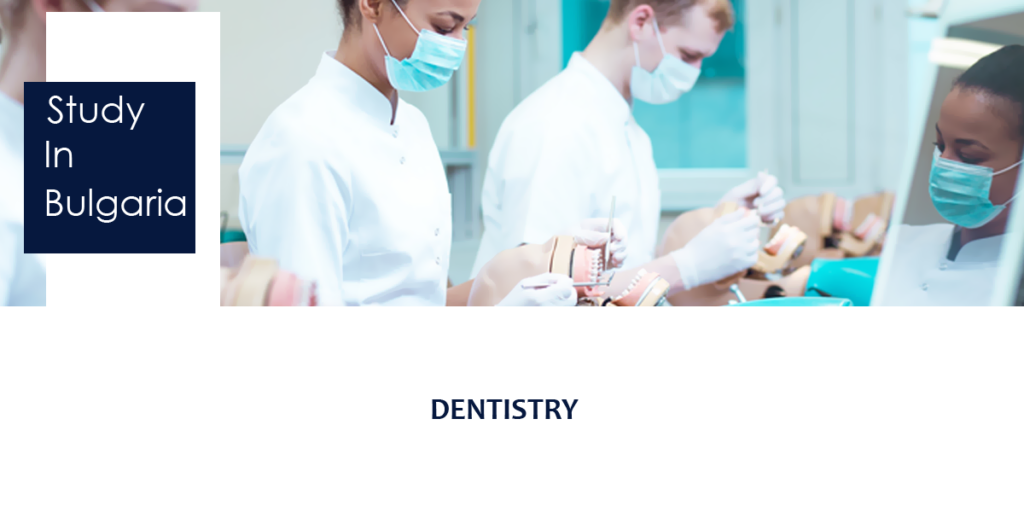
Studying Dentistry in Bulgaria in English has become one of the most popular choices for international students who are looking for high-quality European education at affordable tuition fees. Over the past few years, studying dentistry in Bulgaria has gained strong popularity among Arab and international students due to the combination of modern dental education, internationally recognized degrees, and low living costs.
In addition, Bulgaria medical universities offer advanced dentistry programs aligned with European Union standards, making Bulgaria one of the best destinations to study dentistry in Europe.
Why Study Dentistry in Bulgaria?
There are many reasons why international students choose to study dentistry in Bulgaria.
Study Dentistry in English
First of all, most medical universities in Bulgaria offer dentistry programs fully in English. Therefore, international students can start their studies without needing to learn Bulgarian beforehand.
Internationally Recognized Dental Degrees
In addition, dental degrees from Bulgaria medical schools are recognized across the European Union and in many Arab countries. As a result, graduates can work or continue specialization internationally.
Moreover, studying dentistry in Bulgaria is significantly more affordable compared to countries like Germany, Italy, or Spain, while maintaining high educational quality.
Early Clinical Training
Furthermore, students start practical training early in university dental clinics and hospitals. This helps students gain real clinical experience during their studies.
Student-Friendly Environment
In addition, cities like Sofia, Varna, and Plovdiv offer a safe and international student environment with relatively low living costs.
Best Universities to Study Dentistry in Bulgaria
Bulgaria has several top-ranked medical universities offering dentistry programs in English.
Located in the capital city Sofia, it is one of the most prestigious medical universities in Bulgaria.
- Program: Master of Dental Medicine (English)
- Duration: 5.5 years
- Features: Advanced laboratories, modern dental clinics, experienced faculty
This university offers a comfortable student environment and affordable living costs.
- Program: Dentistry in English
- Features: Modern clinical training and international student community
One of the most popular Bulgaria medical schools among Arab students.
- Program: Dentistry in English
- Features: Modern digital education and continuous clinical training
Dentistry Program Structure in Bulgaria
Duration of Study
Studying dentistry in Bulgaria takes:
5 years and 6 months
It includes:
- Theoretical studies
- Clinical training
- Practical training in university dental clinics
Degree Awarded
After graduation, students receive:
Master of Dental Medicine (MDM)
Language of Study
The program is fully taught in English, with an additional basic Bulgarian language course for clinical communication.
Tuition Fees for Dentistry in Bulgaria
The average tuition fees for dentistry in Bulgaria are:
€10,000 per year
However, fees may vary slightly depending on the university.
Compared to other European countries, studying dentistry in Bulgaria is considered one of the most affordable options while maintaining high-quality education.
Cost of Living in Bulgaria for Students
The average living cost for students in Bulgaria ranges between:
€500 – €700 per month
This includes:
- Accommodation
- Food
- Transportation
- Internet
- Personal expenses
In addition, student cities in Bulgaria are safe and well-equipped for international students.
Admission Requirements for Studying Dentistry in Bulgaria
To apply for dentistry programs in Bulgaria, students usually need:
- High school diploma with Biology and Chemistry
- Entrance exam in Biology and Chemistry
- Eligibility certificate
- NACID recognition certificate
- Valid passport
- Medical certificate
- Passport-sized photos
- Application form
Some universities may also require proof of English proficiency or an internal English test.
Entrance Exams for Dentistry in Bulgaria
Medical universities in Bulgaria require an entrance exam for dentistry programs in English, mainly in Biology and Chemistry.
Entrance Exam Dates 2026
- 04 April 2026 – Online Exam
- 16 May 2026 – Online Exam
- 13 June 2026 – Online Exam
- 16 July 2026 – EU students only
- 03 September 2026 – EU students only
Exam Structure
The entrance exam includes 5 sections:
Multiple Choice Questions (MCQ)
Students choose one correct answer from four options.
Fill in the Blanks
Students complete scientific sentences with correct terms.
Matching Questions
Students match items from two columns.
True or False
Students identify correct and incorrect statements.
Definitions & Explanations
Students explain basic concepts in Biology and Chemistry.
Exam Duration
- Biology: 1 hour 30 minutes
- Chemistry: 1 hour 30 minutes
Both exams are taken on the same day with a short break in between.
Important Notes
- The exam is conducted online
- Passing the entrance exam is mandatory
- Requirements may vary slightly between universities
- Early preparation in Biology and Chemistry is strongly recommended
When Does Admission Start?
Applications usually start in February or early summer, while the academic year begins in October.
Therefore, early application is highly recommended to secure a place in the desired university.
How We Help You Study Dentistry in Bulgaria
At EdrusBG, we support you through the entire process from application to arrival.
Our services include:
- Document preparation and translation
- University application support
- Entrance exam preparation
- Admission letter processing
- Visa assistance
- Accommodation and airport pickup
- Continuous support during studies
Start Your Journey Today
If you are planning to study dentistry in Bulgaria, contact us today to get free consultation and find the best medical university for your future career in Europe.
How to Study Dentistry at Medical University – Varna: 2026 Non-EU Student Guide
If you are a non-EU student looking to study dentistry in Europe, Medical University – Varna (MUV) provides a highly competitive and globally recognized pathway. The Faculty of Dental Medicine at MUV is famous for its state-of-the-art University Dental Centre, which allows international students to study dentistry with hands-on clinical practice using some of the most advanced medical infrastructure in the region.
However, securing a seat to study dentistry in this elite English-taught program requires clear knowledge of the university’s entrance criteria and a firm handle on the Bulgarian student visa process. This complete guide details the exact steps, academic requirements, and financial obligations you need to plan for the 2026 academic year.
Quick Facts: Study Dentistry in English at MUV
| Detail | Specifications |
|---|---|
| Formal Degree Title | Master’s Degree in Dental Medicine (DMD) |
| Duration of Study | 6 years / 12 semesters |
| Language of Instruction | English |
| Tuition Fee (2026/2027) | €10,000 per year (Paid in two equal installments of €5,000 before each semester) |
1. Academic and Language Requirements to Study Dentistry
Before you can be cleared to study dentistry in Bulgaria, your high school background must comply with strict national educational criteria.
High School Grades and Subjects
-
The Official Language Rule: Your high school transcripts must show that you studied and received a final grade in the official language of the country where you graduated.
-
The 65% Minimum Threshold: For non-EU applicants who want to study dentistry, your average final score in your high school’s official language must be at least 65% of the maximum possible grade in that country’s grading system. Optional language classes, pre-med scores, or higher education credits cannot be substituted for this senior high school requirement.
-
British Curriculum Standards: If you follow the British educational system, you must possess 3 GCE A-Level subjects alongside your GCSEs. MUV explicitly notes that they do not accept O-Levels, IGCSEs, AS-Levels, BTEC, or Foundation programs as valid entrance qualifications to study dentistry.
English Language Proficiency
Direct entry into the English dental stream requires verifiable proof of your English language abilities through one of the following standard routes:
-
Accepted Certificates: An IELTS Academic score of at least 6.5, a TOEFL iBT score of at least 90, a TOEFL PBT score of at least 576, a Cambridge FCE score of 190 or higher, or a PTE Academic score of 61 or higher.
-
High School Exemption: If you completed your high school education in the UK, USA, Canada, Australia, Ireland, or New Zealand, you are exempt from providing a test certificate. However, your high school English grade must be at least “Very Good” (or Grades 6 to 9 for the British GCSE system).
Note: If you do not have these scores or qualifications, you will need to take an internal English exam administered by the university or complete a 9-month English preparatory year costing €5,000 before you can officially study dentistry here.
2. The 2026 Dentistry Entrance Exams
All qualified applicants who want to study dentistry at MUV must pass two distinct entry tests: one in Biology and one in Chemistry.
Test Formats
The entry tests are conducted entirely in English. You are given 1 hour and 30 minutes for each subject, and both are sat on the same date. The tests include a combination of multiple-choice questions, gap-filling tasks, matching columns, true/false statements, and short written definitions. There are no point deductions for incorrect answers.
2026 Test Dates
The university schedules these online exams on specific dates throughout the spring:
-
April 04, 2026
-
May 16, 2026
-
June 13, 2026
Exam Registration and Fees
To select and register for your exam date, you must create an account on the MUV online application system (http://e-application.mu-varna.bg). A non-refundable application fee of €340 must be paid to the university’s bank account no later than one week before your chosen test date.
3. Legalizing and Mailing Your Paper Documents
Once your online portal profile is reviewed by the university and marked as “Successfully Registered,” you must prepare your physical application folder to secure your spot to study dentistry.
The Document Checklist
-
Application Form: Printed, dated, and signed directly from the online platform.
-
High School Diploma: A certified copy of your graduation certificate.
-
Academic Transcript: A certified copy showing all studied subjects and final grades achieved.
-
Eligibility Letter: An official document from your high school or Ministry of Education stating that your diploma legally entitles you to pursue higher education in the country where you graduated. (Indian nationals looking to study dentistry abroad must provide an Eligibility Certificate for BDS admission issued by the National Testing Agency/NTA).
-
Parental Financial Declaration: A notarized statement from a parent or relative confirming they will support your financial costs while you study dentistry in Bulgaria.
-
Passport Copy: A clear copy of the page containing your personal information and photo.
-
Photos: Five recent passport-sized color photographs.
-
Name Affidavit: Only required if your name is spelled differently on any of your high school documents compared to your international passport.
The Legalization Process (Strictly Enforced)
Bulgarian authorities do not accept standard photocopies or digital printouts. Your diploma, transcript, and eligibility letter must carry original, wet-ink legalization stamps using one of these two methods:
-
Apostille: If your country is a member of the Hague Convention, your documents must obtain an official Apostille stamp from the authorized government office in that country.
-
Consular Legalization: If your country is not part of the Hague Convention, your documents must be stamped by your local Ministry of Education, your Ministry of Foreign Affairs, and finally by the Bulgarian Embassy in your country.
-
Translation: All legalized documents must be officially translated into Bulgarian by an authorized translation agency or a Bulgarian consular official.
The Deadline
Your physical document package must be sent by post or delivered via a representative to the MUV Office of Admissions in Varna by September 11, 2026. This package will undergo mandatory evaluation by the Bulgarian institution NACID for formal credential recognition, a procedure that takes roughly one month.
4. How the University Ranks Applicants
Simply passing the entrance exams does not guarantee you will get to study dentistry at MUV, as the university receives more international applications than the available quota allows. Candidates compete against one another based on a rigid scoring system.
The university calculates your final entry score out of a maximum of 42 points using this exact formula:
Important: If you receive a failing mark on either the Biology or Chemistry entrance test, you are automatically disqualified and cannot be included in the final ranking lists to study dentistry.
5. What Happens After Acceptance: Visas and Fees
As a non-EU student, your admission involves an additional step with the Bulgarian government before you can legally travel to Europe to study dentistry.
-
Ministry of Education Approval: MUV submits your verified files to the Ministry of Education and Science in Sofia. The Ministry takes up to a month to issue an official certificate confirming your right to study.
-
University Certificate Fee: You must transfer a small €5.11 administrative fee to the university bank account to order your official university admission documents.
-
The Advance Tuition Requirement: This is a critical rule to remember. You cannot pay your tuition after you arrive in Bulgaria. The university will only send you the original Ministry Certificate and Admission Assurance—both mandatory for your visa interview—after you pay your first semester tuition fee of €5,000.
-
Visa D Application: You must schedule a personal interview at the nearest Bulgarian Embassy or Consulate to apply for your Long-Stay Student Visa (Visa D) using the original certificates mailed to you by the university.
6. Arriving in Varna and Final Enrollment
Once your Visa D is approved and inside your passport, you can travel to Varna to register as an active dental student. You must complete your enrollment in person at the Faculty of Dental Medicine Student Affairs Office located at 84 Tzar Osvoboditel Street, Floor 2, Room 201A.
Documents Needed at the University Registry:
-
The hard-copy bank receipt showing you transferred your €5,000 first semester tuition fee.
-
A valid health insurance policy that covers the territory of Bulgaria for the entire academic year.
-
Your physical student booklet, index book, and ID cards (purchased directly from the university bookstore on campus at 55 Marin Drinov Street).
-
Your passport containing your valid Visa D.
Registering with the Varna Migration Office
Within five days of landing in Bulgaria, you must register your arrival address at the Varna Migration Office. Before your initial Visa D expires, you must apply for your physical Residence Permit Card (RPC). This card requires your university status documents, your tuition receipt, a legalized criminal record check, and a local bank statement showing a minimum of 1,500 Leva. The RPC must be renewed every 6 to 12 months for the duration of your dental degree.
Approximate Monthly Cost of Living in Varna
One of the distinct benefits of choosing to study dentistry in Bulgaria is that the cost of living remains significantly more affordable than in Western Europe or North America. Most international students live comfortably on a budget of €450 to €650 per month.
Estimated Student Expenses Breakdown
| Expense Type | Average Monthly Cost |
|---|---|
| Private One-Bedroom Apartment | €250 – €400 (cheaper if sharing with roommates) |
| Food and Groceries | €250 – €350 |
| Utilities (Electricity, Water, Heating) | €111 |
| Internet and TV | €12 |
| Local Public Transport Pass | €21 |
| Leisure, Sports, and Pocket Money | €150 |
Advisor’s Recommendation on Timelines
The sequence of gathering your documents, getting them legalized, waiting for the NACID and Ministry certificates, and applying for the visa takes between 2 and 3 months.
If your dream is to study dentistry at Medical University – Varna, do not wait until the September deadline to submit your documents. I highly recommend having your paperwork ready for review by April or May to ensure you do not face unexpected administrative delays before the winter semester starts.
Frequently Asked Questions About Studying Dentistry in Bulgaria
Yes, studying dentistry in Bulgaria is a great option because Bulgaria offers high-quality dental education, English-taught programs, affordable tuition fees, and internationally recognized degrees across Europe and many other countries.
Tuition fees for dentistry in Bulgaria usually cost around €10,000 per year, depending on the university. Compared to other European countries, it is considered more affordable.
Yes, dentistry degrees from Bulgaria medical universities are recognized in the European Union and in many Arab and international countries, allowing graduates to work or continue specialization abroad.
Yes, most medical universities in Bulgaria offer dentistry programs fully taught in English, making it accessible for international students without needing to learn Bulgarian before starting.
Students usually need a high school diploma with Biology and Chemistry, pass an entrance exam in Biology and Chemistry, provide translated documents, and meet English language requirements depending on the university.
